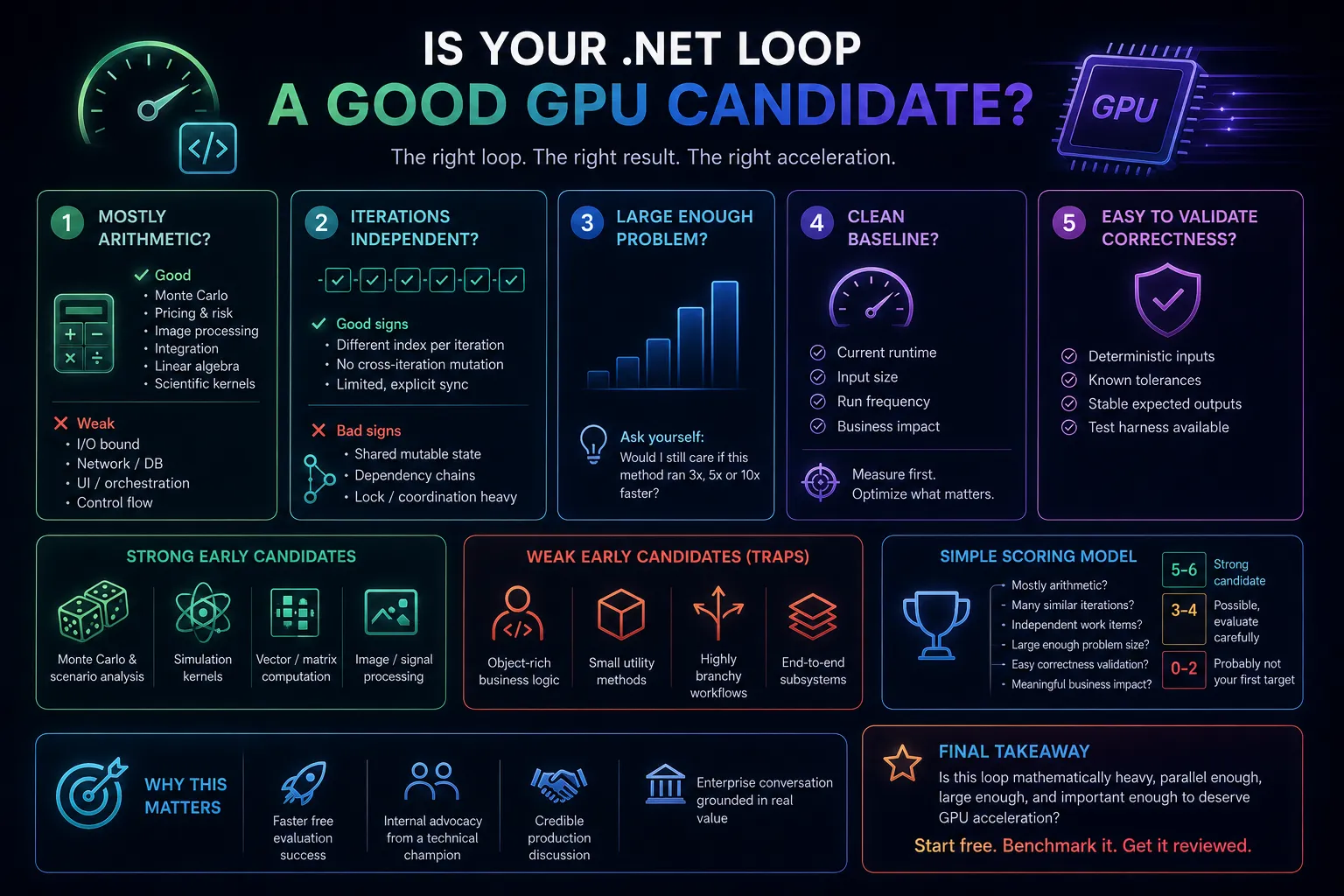
Not every slow .NET method belongs on a GPU.
That sounds obvious, but teams still lose weeks trying to accelerate workloads that were never good candidates in the first place.
The fastest way to evaluate Hybridizer is to identify a loop that already has the right shape for GPU work.
The short answer
Your .NET loop is a strong GPU candidate when it is:
- numeric
- repeated many times
- parallelizable
- heavy enough to amortize launch and transfer overhead
- easy to validate for correctness
If it is object-heavy, branchy, stateful, or dominated by I/O, the answer is usually no.
A simple evaluation checklist
1. Is the work mostly arithmetic?
Good candidates spend time doing math.
Examples:
- Monte Carlo simulation
- pricing and risk calculations
- image processing
- numerical integration
- linear algebra and vector transforms
- scientific kernels
Weak candidates spend most of their time on:
- network calls
- file I/O
- database access
- UI logic
- orchestration and control flow
2. Can iterations run independently?
The GPU likes large amounts of similar work.
A strong loop usually applies the same logic over many elements with minimal coordination.
Good signs:
- each iteration operates on a different index
- outputs do not depend on cross-iteration mutation
- synchronization needs are limited and explicit
Bad signs:
- lots of shared mutable state
- unpredictable dependency chains
- lock-heavy or coordination-heavy logic
3. Is the problem large enough?
A tiny loop rarely justifies GPU overhead.
You want enough work to make offloading worthwhile.
A useful rule of thumb is to ask:
Would I still care about this method if it ran 3x, 5x, or 10x faster?
If the answer is no, it may not be the right first target.
4. Can you measure a clean baseline?
Before accelerating anything, you need to know:
- current runtime
- input size
- how often it runs
- business impact of speeding it up
This prevents a common failure mode: teams optimizing a technically interesting method that does not matter enough to move the product.
5. Is correctness easy to verify?
The best first Hybridizer candidate is one where you can compare GPU and CPU outputs with confidence.
Strong evaluation targets have:
- deterministic inputs
- known tolerances
- stable expected outputs
- a small test harness or benchmark already available
If you cannot confidently prove the result is correct, you do not yet have a good first candidate.
Strong early candidates
These are usually good starting points for Hybridizer:
Monte Carlo and scenario analysis
Lots of repeated work, often numerically heavy, and common in finance and insurance.
Simulation kernels
When the same update logic applies across many elements or timesteps, GPUs become interesting quickly.
Vectorized or matrix-oriented computation
If you are already thinking in arrays and bulk operations, the workload is often a good fit.
Batch image or signal processing
When the same transform applies across large datasets, throughput can matter a lot.
Weak early candidates
These are common traps:
Object-rich business logic
If the code is mostly navigating domain models, the GPU is probably the wrong tool.
Small utility methods
Even if they are slow in isolation, they may not justify offload overhead.
Highly branchy workflows
When each element behaves differently, performance predictability often degrades.
End-to-end subsystems
Do not start by accelerating “the reporting pipeline” or “the analytics service.” Start with one kernel-worthy bottleneck inside them.
A simple scoring model
Give your candidate loop 1 point for each yes:
- mostly arithmetic?
- many similar iterations?
- independent work items?
- large enough problem size?
- easy correctness validation?
- meaningful business impact if faster?
Interpretation:
- 5–6 points: strong candidate
- 3–4 points: possible, but evaluate carefully
- 0–2 points: probably not your first Hybridizer target
Final takeaway
Do not ask “Can this code run on the GPU?” first. Ask:
Is this loop mathematically heavy, parallel enough, large enough, and important enough to deserve GPU acceleration?
That question will save your team far more time than any benchmark chart.
If you want to validate one specific method, start free and benchmark it, or send the workload to the team for review.